
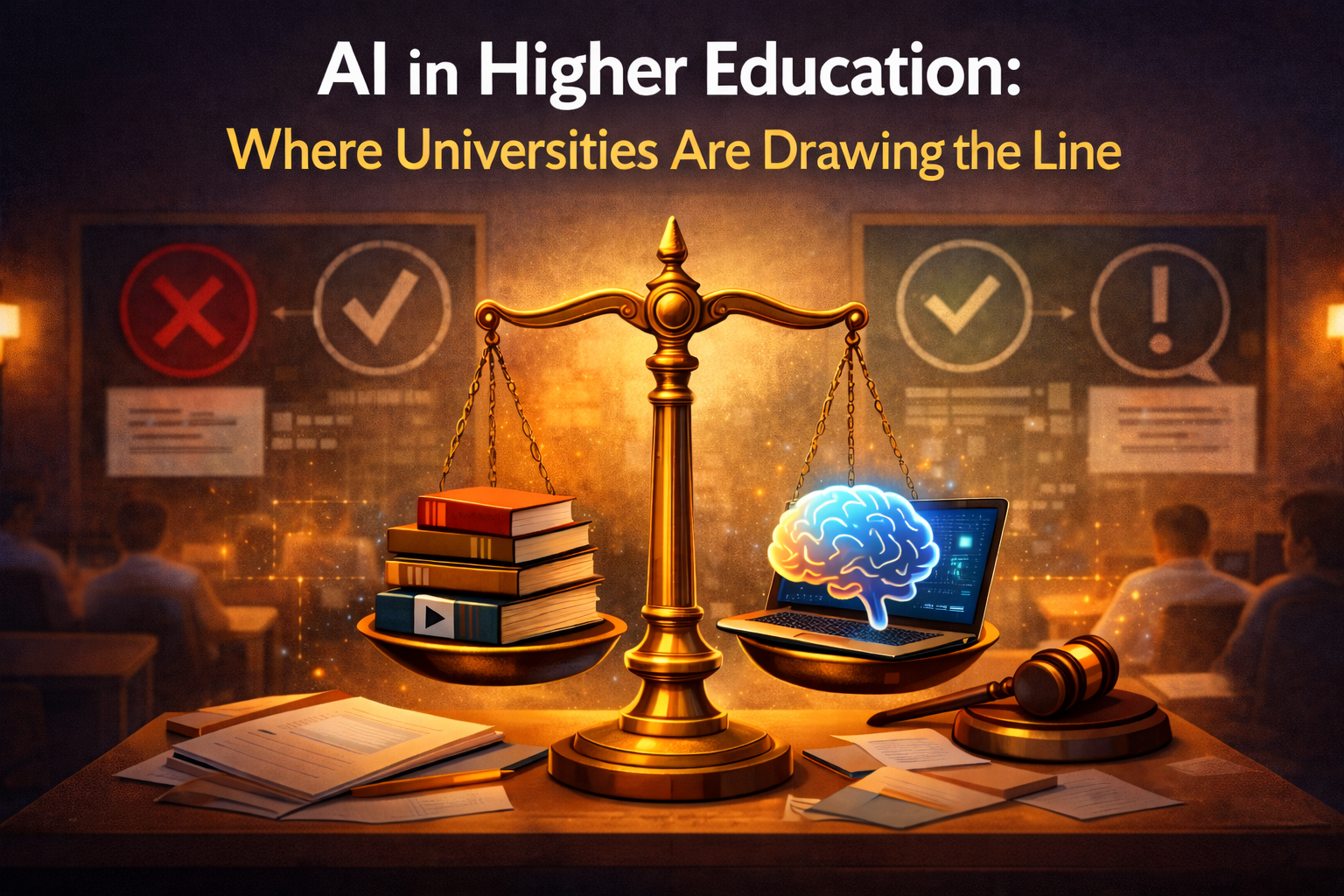
Universities are on the horns of a dilemma, as AI becomes increasingly integrated into students’ everyday work, how can a policy be built to keep pace with a technology changing more rapidly than legislation and governance processes can hope to achieve?
From generating essays and performing literature reviews to providing research support, AI is beginning to bypass many aspects of student work. But in the background, the universities themselves have a pressing issue:
Where should the boundary be drawn between aid and academic dishonesty?
An evolving policy landscape
At the moment, there is no consensus as to how AI should be applied in higher education. Some universities; Promote the responsible use of AI; Integrate AI in learning. Other universities; Limiting AI’s role in assessments; consider AI-generated content to be potential academic misconduct. This creates a lack of a coherent system in which to educate students and the confusion of an acceptable mode of usage that will differ from class to class.
An issue with definitions
Part of the problem stems from the difficulty in defining what constitutes ‘the use of AI’. Consider how use might differ for a student; Researching ideas; outlining; writing the full text; or revising work. At what point does help cross over into becoming replacement? Furthermore, unlike classic academic plagiarism where work has been replicated word-for-word, work generated by an AI is not always evidence of existing work.
Worries among educators
A major concern for teachers is that the wide use of AI may: discourage students’ own thoughts, produce work that is not the student’s own, and therefore be more difficult to assess. Work previously used to measure thinking as well as learning can:. When AI handles that, the assignment itself may require reassessment.
Change in assessment models
It’s not everyone in some institutions that has started to change. A lot of new techniques are being developed such as oral assessments, in-class writing tasks and project work. These are assessment types that rely on testing understanding in different ways and types of work.
The argument for integration
Not all teachers are of the view that banning is the way to go. AI is perceived in a similar way to other tools used in education such as calculators in math, software for engineers, and research databases for humanities; we need to embrace and adapt the technology. Banning is not a feasible and the students will have to learn how to use it.
Towards responsible use
Growing agreement towards responsible use, that involves: reporting the use of AI, critically evaluating the produced output, ensuring original work and intent Integration, rather than rejection, may be the best response.
Conclusion
AI is not merely a technical innovation, but a change of how knowledge is created and applied Universities are yet to decide on their official position while maintaining a balance between innovation and integrity For the students the task is to not only obey rules, but understand their intention.
Common Questions
Is using AI for assignments considered cheating?
It depends on institutional policies. Using AI for assistance (such as brainstorming or structuring) is often acceptable, while submitting fully AI-generated work may violate academic guidelines.
How can students use AI responsibly?
Students can use AI responsibly by treating it as a support tool, verifying outputs, and ensuring their final work reflects their own understanding.


Leave a Reply