

In universities around the country, artificial intelligence is being credited with solving one of the longest-standing dilemmas of student life:
Time
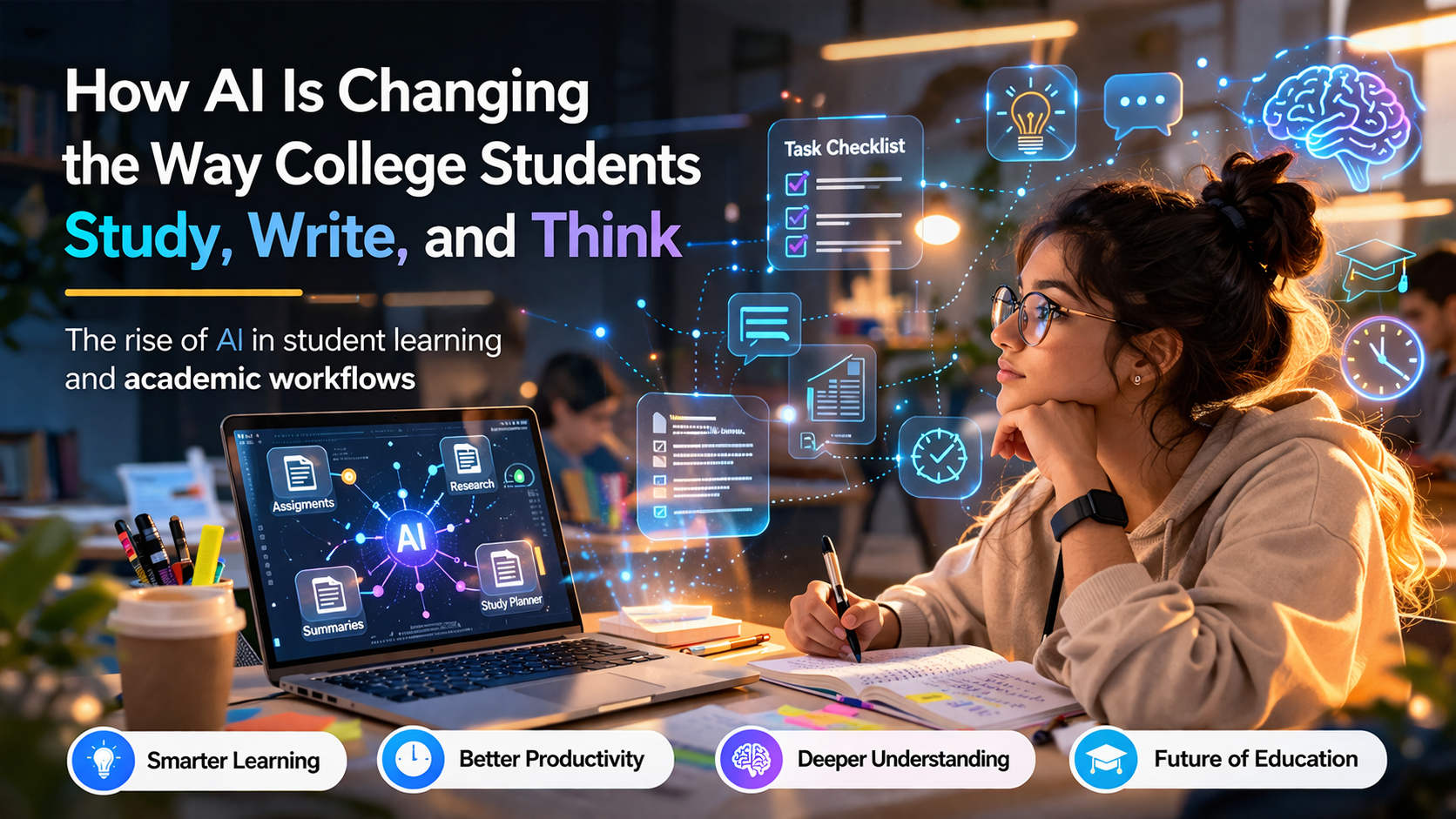
With AI now producing notes, organizing essays, and even writing student replies, a significant number of college students report they are finishing coursework faster than they ever have before. But a more subtle, nuanced question underlies this promise of speed:
AI tools for productivity increasing or output speed just speeding up?
Speed vs. Understanding
The immediate advantages seem clear: Brainstorming, analyzing ideas, organizing arguments, drafting outlines; an hour of intellectual heavy lifting may now only require minutes with tools like ChatGPT.
But true student productivity isn’t solely about velocity, and it should also include:
- An increase in depth of understanding.
- An ability to synthesize complex information.
- Long-term knowledge retention.
If AI assists in the initial stages of thought, student may not engage in the deeper intellectual engagement that normally fosters this learning.
The New student workflow
Students are no longer writing from scratch. They are already using a new workflow:
Idea Generation by AI > Expand by AI into outline > Edit and refine
Undeniably effective. The trade-off, however, is that the students’ task has moved from creation to editing.Editing is a critical skill, but the overuse of generation will stunt the creation of unique thought.
The Dangers of cognitive offloading
Psychologists call this “cognitive offloading”: a tendency to shift the responsibility of the mental work of a task to external tools. This can be helpful:
- Use calculator for calculation
- Use spell-check to catch typos
However, this can also cause
- Reduced problem solving skills
- Worse memory
- Reliance on tools
The fear is not students using AI but students ceasing to practice the things school is supposed to help them develop.
Perception Vs. Reality
Students perceive speed in task completion as a sign of productivity. However, task completion is not equal to learning,
Completion of task Vs Skill development.
A task finished in 30 minutes is sufficient, yet it does not ensure proficiency in the topic.This can lead to what could be termed a productivity illusion – a feeling of achievement that might not stem from actual learning.
A Balanced perspective
This does not imply that the use of AI is wrong, and if approached intelligently it can:
1. Eliminate some of the tediousness,
2. Aid overcoming creative blocks and structure thought.
However, the use is dependent on the learning context. The most useful applications of AI tend to occur when students are:
1. Starting point rather than an end result,
2. Checking and editing output, and incorporating own perspective.
Conclusion
In conclusion, there is no doubt that artificial intelligence has changed the way students go about their work. It has accelerated, democratized, and made the learning experience less daunting, in many respects. However, true productivity in education isn’t simply about doing more in less time; it’s about learning, comprehending and thinking critically. As AI advances, the nature of what it means to be productive for students may have to change, not just in terms of the amount they produce, but in terms of what they achieve.
Common Questions
Does AI actually make students more productive?
AI increases speed and reduces effort for repetitive tasks. However, true productivity depends on whether students actively engage with the material.
What is the “productivity illusion” in education?
The productivity illusion refers to the feeling of being efficient due to faster task completion, even when actual understanding or skill development may be limited.


Leave a Reply